Most enterprises treat Security, Cloud and AI as separate transformation tracks. Different teams. Different budgets. Different roadmaps. Different KPIs. On paper, this looks organized. In reality, it creates fragmentation, duplicated investments and invisible risk.
In 2026, these three domains are no longer parallel functions. They are interdependent infrastructure layers. Solving them in silos is not just inefficient. It is expensive.
Cloud teams focus on scalability and uptime. Security teams focus on control and compliance. AI teams focus on speed and innovation. Each function optimizes for its own outcome. But AI runs on cloud. Cloud expands attack surfaces. Security must govern both AI models and cloud architecture.
When these strategies are disconnected, organizations experience:
- Security retrofitting after AI deployment
- Cloud cost overruns from ungoverned AI workloads
- Compliance risks from unmanaged data pipelines
- Shadow AI experiments outside secure infrastructure
Siloed optimization leads to enterprise-level inefficiency.
The financial impact is rarely visible in one budget line.
It shows up as:
- Re-architecting cloud environments to fix security gaps
- Rebuilding AI pipelines due to governance violations
- Incident response costs due to misconfigured cloud assets
- Redundant tooling across teams
- Slower innovation cycles due to cross-functional friction
The cost of misalignment compounds over time.
Security, Cloud and AI are no longer independent capabilities. They are a unified operating model. AI workloads demand elastic cloud infrastructure. Cloud-native architectures expand threat vectors. Security must be embedded across AI models, data layers and cloud workloads.
Leaders are shifting from vertical ownership to horizontal governance.The new question is not How do we secure AI? It is How do we design AI, Cloud and Security as one ecosystem?
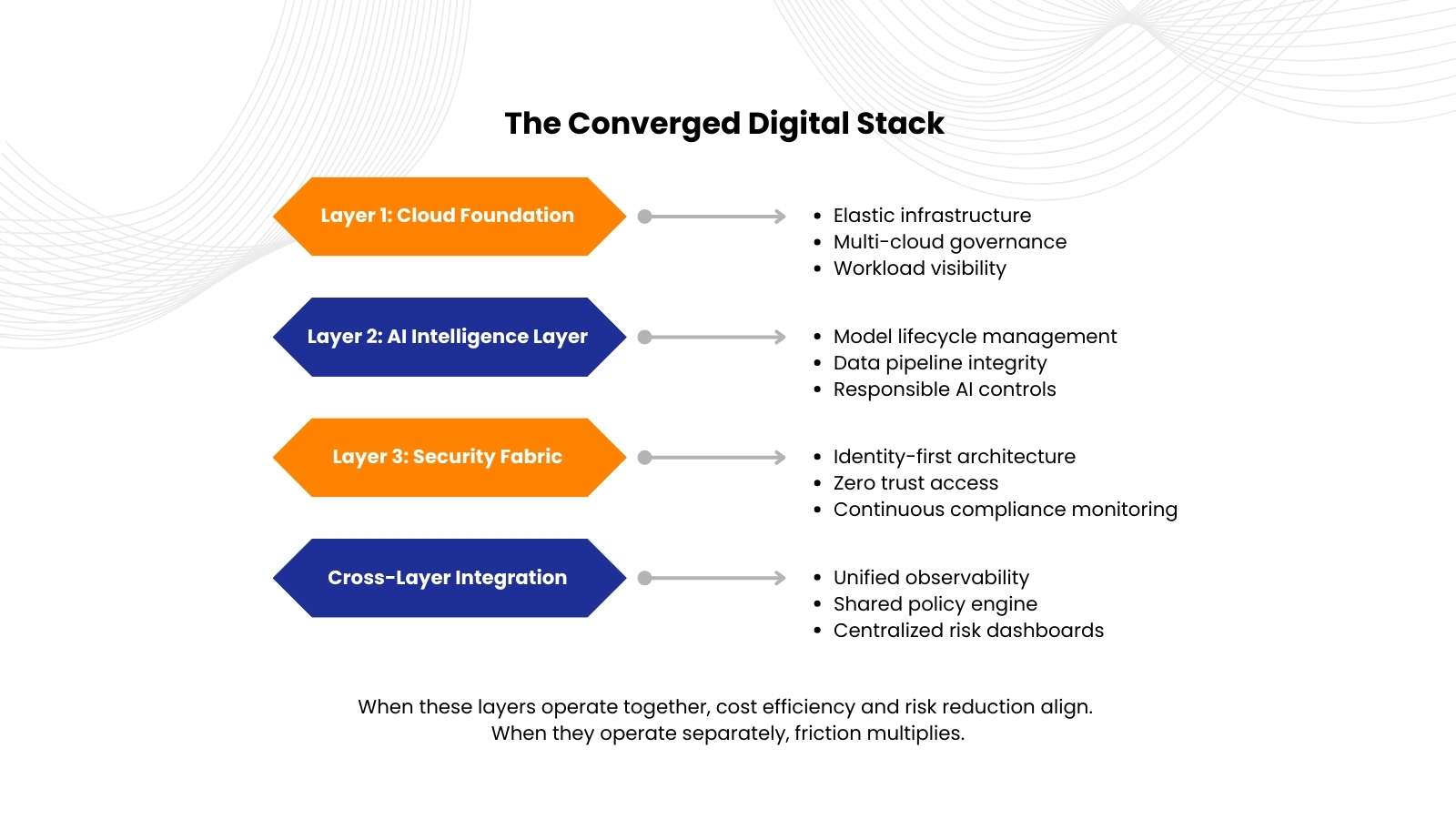
Why Siloed Investments Fail at Scale
- Governance breaks down Security policies often do not extend into AI experimentation environments or cloud-native microservices.
- Tool sprawl increases Separate procurement decisions create overlapping platforms and integration challenges.
- Accountability blurs When incidents occur, ownership becomes unclear across teams.
- Innovation slows AI teams wait for security approvals. Security teams react to post-deployment risks. Cloud teams manage cost without context of AI growth plans.
Fragmentation reduces enterprise agility.
That means:
- Shared architecture councils across AI, Security and Cloud
- Unified KPIs aligned to risk, performance and innovation
- Centralized identity and access governance
- Cloud cost visibility mapped to AI workloads
- Embedded security within AI model development
When Security, Cloud and AI are architected together:
- AI scales without uncontrolled cost growth
- Security becomes proactive rather than reactive
- Compliance becomes continuous rather than periodic
- Innovation cycles accelerate
Integration reduces hidden expenses and strategic risk.
The Real Cost Question
The issue is not whether you are investing in Security, Cloud and AI. The issue is whether those investments are compounding or colliding.
In 2026, competitive enterprises will not treat these as separate modernization initiatives. They will treat them as a single digital foundation. The cost of silos is not just financial. It is strategic.
How Skillmine Helps Enterprises Converge
At Skillmine, we work with organizations that are ready to move beyond fragmented transformation.
Our approach integrates:
- Cloud modernization with embedded security controls
- AI enablement aligned to governance frameworks
- Identity-first architectures across hybrid environments
- Continuous compliance built into digital infrastructure
Instead of layering AI onto cloud or retrofitting security after deployment, we help enterprises architect these capabilities as one cohesive ecosystem.
Because scalable innovation only happens when infrastructure, intelligence and protection evolve together.
If your Security, Cloud and AI strategies are running on separate tracks, it may be time to redesign the operating model.
The next phase of digital leadership belongs to organizations that build convergence by design.
The issue is not whether you are investing in Security, Cloud and AI. The issue is whether those investments are compounding or colliding.
In 2026, competitive enterprises will not treat these as separate modernization initiatives. They will treat them as a single digital foundation. The cost of silos is not just financial. It is strategic.