Many enterprises continue to treat legacy infrastructure as a sunk cost. The servers are paid for. The systems are stable. The applications still run.
On the surface, nothing appears broken.
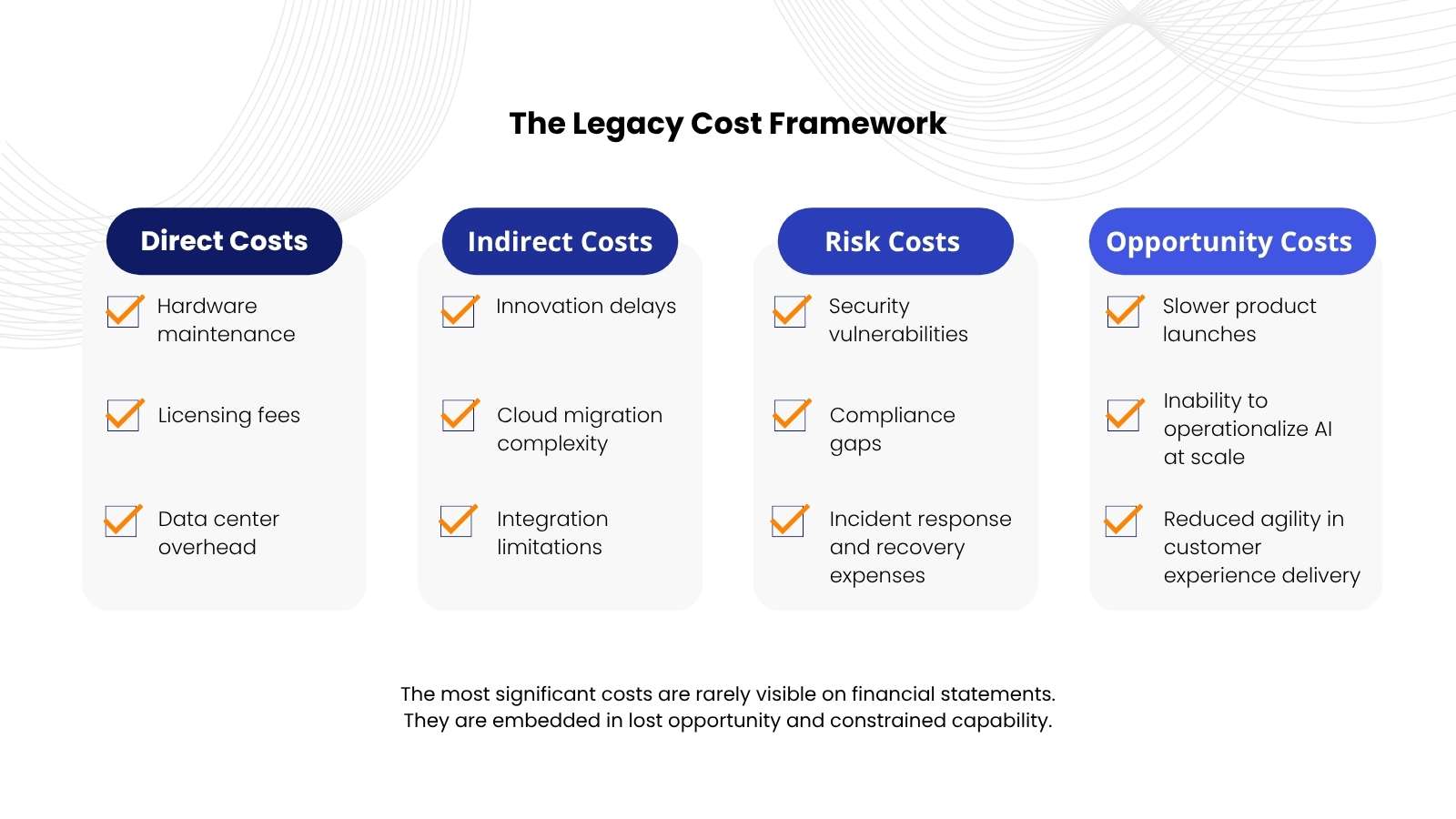
But the real cost of legacy infrastructure is not reflected in maintenance budgets or depreciation cycles. It manifests in slower decision-making, constrained innovation, and an expanding risk surface that is difficult to quantify yet increasingly difficult to ignore.
In a cloud-native world, legacy infrastructure does not simply lag behind. It quietly compounds strategic disadvantage.
Legacy Stability Is Not Strategic Readiness
Legacy systems were engineered for a different era, one defined by predictability, controlled environments, and incremental change.
Cloud-native ecosystems operate on entirely different principles. Elasticity, continuous deployment, distributed architectures, and real-time data flows are now the baseline.
This divergence is not just technical. It defines competitive posture.
Cloud-native organizations deploy faster, scale dynamically, and integrate emerging technologies like AI with minimal friction. They are structurally designed to adapt.
Legacy-bound enterprises, on the other hand, operate within rigid architectural constraints. Every new initiative must navigate existing limitations, often requiring compromise before execution even begins.
The implication is clear. Stability, while valuable, does not equate to readiness. In many cases, it masks an inability to evolve at the pace the market demands.
Where the Hidden Costs Accumulate
The cost of legacy infrastructure rarely appears as a single, measurable line item. It is distributed across multiple dimensions of the organization, often surfacing as inefficiencies rather than direct expenses.
1. Innovation Drag
Modern digital services depend on modular architectures, API-driven integrations, and scalable compute layers.
Legacy systems frequently lack:
- Modular design
- Real-time data accessibility
- Flexible integration frameworks
- AI-ready data pipelines
As a result, engineering teams are forced into building layers of abstraction and workarounds. Instead of accelerating innovation, effort is diverted toward maintaining compatibility.
Over time, this creates a compounding effect where innovation is not just delayed, but structurally inhibited.
2. Cloud Migration Friction
Hybrid transformation strategies are often positioned as a pragmatic path forward. In practice, legacy infrastructure introduces significant friction into these efforts.
Common challenges include:
- Complex re-platforming requirements
- Extended application refactoring cycles
- Deep-rooted compatibility constraints
- Prolonged migration timelines
Rather than enabling transformation, legacy environments often act as anchors, slowing progress and increasing execution risk.
The longer these dependencies persist, the more expensive and complex modernization becomes.
3. Security Exposure
Legacy systems were not designed for the current threat landscape, where attack vectors are dynamic and increasingly sophisticated.
Typical vulnerabilities include:
- Unsupported or end-of-life software
- Inconsistent patch management
- Limited observability and logging
- Fragmented or weak identity controls
In contrast, cloud-native security models are built around zero trust, continuous monitoring, and centralized identity frameworks.
When legacy systems coexist within this environment, they introduce inconsistencies that expand the attack surface. For CISOs, this creates blind spots that are difficult to defend and even harder to monitor effectively.
4. Operational Inefficiency
Operational overhead is another area where legacy costs accumulate quietly.
These environments often depend on specialized skill sets that are becoming increasingly scarce. This leads to:
- Rising maintenance costs
- Dependence on outdated tooling
- Slower incident response and troubleshooting
- Increased risk of unplanned downtime
What appears as operational stability can, over time, become operational fragility.
The Convergence Reality in 2026
Security, Cloud and AI are no longer independent capabilities. They are a unified operating model. AI workloads demand elastic cloud infrastructure. Cloud-native architectures expand threat vectors. Security must be embedded across AI models, data layers and cloud workloads.
Leaders are shifting from vertical ownership to horizontal governance.The new question is not How do we secure AI? It is How do we design AI, Cloud and Security as one ecosystem?
Cloud-native is not simply about relocating infrastructure. It represents a fundamental shift in how systems are designed, deployed, and secured.
At its core, it is built on:
- Containerization
- Microservices-based architectures
- API-first integration models
- Continuous integration and deployment
- Automated scalability and resilience
These capabilities enable organizations to operate with speed and precision.
However, when legacy systems remain deeply embedded, they create persistent friction against this model. AI workloads require elastic compute and high-throughput data pipelines. Modern security frameworks demand unified identity and telemetry. Digital platforms depend on real-time data exchange.
Legacy infrastructure was not designed to support these requirements. The result is a disconnect between strategic ambition and operational capability.
The Strategic Modernization Imperative
Modernization is often deferred because legacy systems continue to function. The perceived risk of change outweighs the visible cost of maintaining the status quo.
But stability without scalability leads to stagnation.
Forward-looking enterprises are taking a more structured approach:
- Identifying high-friction legacy workloads that impact agility
- Prioritizing application re-architecture over superficial migration
- Aligning cloud adoption with security transformation initiatives
- Embedding governance and compliance into modernization roadmaps
Importantly, modernization is not about wholesale replacement. It is about systematically reducing the constraints that limit growth and adaptability.
The Leadership Question
For CISOs and technology leaders, the question is no longer whether legacy systems are operational.
The question is whether they are aligned with the organization’s future.
Are they enabling faster response to emerging threats? Are they supporting the integration of AI-driven capabilities? Are they providing the visibility and control required in a distributed environment?
If the answer to any of these is no, the cost is already being incurred.
How Skillmine Accelerates Modernization
At Skillmine, modernization is approached as a strategic transformation rather than a technical upgrade.
The focus is on aligning infrastructure with business objectives while embedding security and governance from the outset.
Our approach includes:
- Cloud readiness assessments aligned to business priorities
- Application modernization strategies designed for scalability and resilience
- Security-first architecture integrated throughout the migration lifecycle
- Continuous compliance frameworks across hybrid and multi-cloud environments
This ensures that modernization efforts do not introduce new risks while resolving existing constraints.
Modernization is not a lift-and-shift exercise. It is an architectural realignment that positions infrastructure as a driver of innovation rather than a barrier.
If legacy systems are limiting your cloud-native ambitions, the cost is not theoretical. It is already impacting your ability to compete, adapt, and secure your environment.
The only variable is how long that cost is allowed to accumulate.