Singapore has firmly positioned itself as one of the world’s most advanced digital economies, and the scale of investment reflects both ambition and intent. With Microsoft committing $5.5 billion toward AI and cloud infrastructure, and Google continuing to expand its data center and AI footprint across Southeast Asia, the region is rapidly emerging as a global hub for AI innovation.
This momentum is reinforced by the broader ecosystem. Singapore today accounts for over 60% of Southeast Asia’s data center capacity, with the market projected to exceed $7–8 billion by 2028. Enterprise AI adoption has also crossed 60%, placing the country among global leaders. On the surface, this reflects what AI leadership should look like. However, within enterprises, the narrative is evolving. AI adoption is no longer the primary challenge. Value realization is.
A. The ROI Gap: Where Investment Falls Short
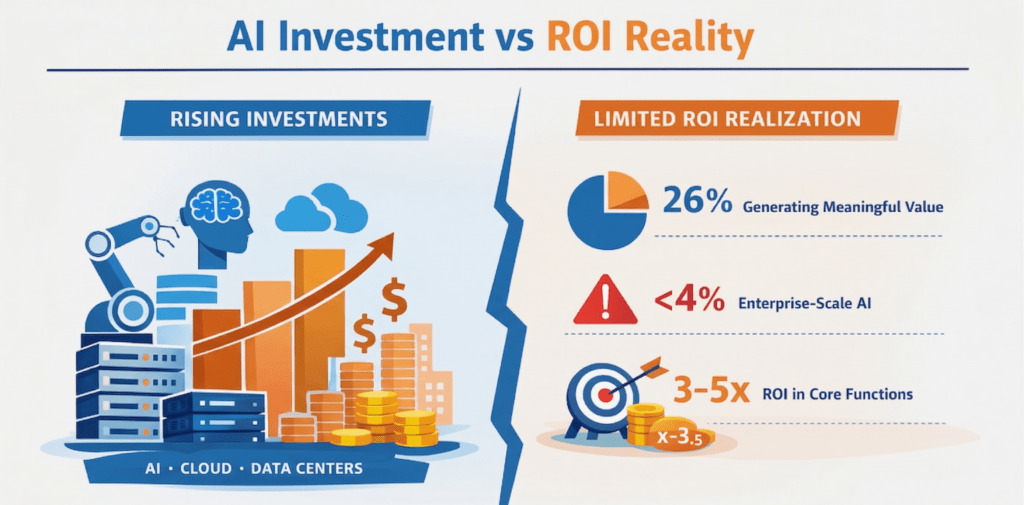
Despite aggressive investments, most organizations are still struggling to translate AI into measurable business outcomes.
- Only 26% of companies are generating meaningful value from AI
- Fewer than 4% have achieved enterprise-scale transformation
This is not a gap in ambition but a gap in structure. Across enterprises, a consistent pattern is emerging. Capabilities are often built ahead of clearly defined use cases, and AI is largely applied to incremental efficiencies rather than core business transformation. Data ecosystems remain fragmented, limiting the effectiveness of AI models, while a significant number of initiatives continue to remain confined to pilot or experimentation stages. Even in cases where ROI exists, it is rarely measured with clarity or communicated effectively.
Organizations that embed AI into core business functions see three to five times higher financial impact, yet most continue to operate at the periphery. At the same time, persistent data quality challenges continue to erode potential returns. The result is a widening disconnect where AI capability is scaling faster than the business value it is expected to generate.
B. The Execution Challenge: Why AI Fails to Scale
If structural misalignment creates the gap, execution determines whether it can be closed. AI initiatives rarely fail at the ideation stage; they falter during scaling, integration, and ownership. A relatively small percentage of initiatives successfully transition beyond pilot phases, even as investments continue to accelerate faster than realized returns.
This has led to a noticeable shift in leadership priorities, from a focus on adoption to a sharper emphasis on accountability and measurable outcomes. In practice, execution challenges tend to manifest in predictable ways. There is often limited alignment between business objectives and AI initiatives, making it difficult to tie outcomes directly to strategic goals. Integration with legacy systems introduces additional complexity, slowing down deployment and reducing impact. Ownership frequently dissipates beyond initial pilot stages, and in the absence of clearly defined success metrics, initiatives struggle to demonstrate value.
As a result, many organizations find themselves in a recurring cycle where strong investments lead to promising pilots, but fail to translate into enterprise-scale outcomes. The transition from pilot to production becomes the critical inflection point, and it is precisely where most AI programs lose momentum.
C. From Adoption to Impact: What Needs to Change
As Singapore’s AI ecosystem matures, the next phase of leadership will not be defined by the scale of investment, but by the ability to extract tangible value from it. This requires a deliberate shift in approach, moving from experimentation to outcome-driven execution, from isolated initiatives to enterprise-wide integration, and from an infrastructure-led mindset to one centered on business impact.
Skillmine’s approach is grounded in this shift. The objective is not to introduce additional layers of AI capability, but to ensure that existing investments translate into measurable outcomes.
- Aligning AI initiatives with core business KPIs
- Enabling seamless transition from pilot to production at scale
- Strengthening data foundations and governance frameworks
- Embedding AI into operational and decision-making workflows
- Driving engineering-led execution to ensure sustained impact
In a market like Singapore, where foundational infrastructure and adoption levels are already strong, execution becomes the defining differentiator.
Closing Perspective
Singapore has already achieved what many economies continue to aspire toward: a robust digital and AI foundation. The next phase is not about increasing investment, but about maximizing returns on what already exists.
In today’s AI landscape, technology is no longer scarce, and experimentation alone is no longer sufficient. Execution is the differentiator, and ROI is the true measure of success. Organizations that successfully bridge this gap will not just adopt AI. They will lead with it.
If your organization is investing in AI but not seeing measurable outcomes, the challenge is not capability, but execution. Discover how Skillmine helps enterprises translate AI investments into real business impact: https://www.skill-mine.com