The Missing Governance Layer for Windows Task Scheduler, Services, and Infrastructure Credentials
Most organizations believe their password security is under control. Multi-factor authentication is enabled, endpoints are protected, and firewalls are in place. Yet one of the biggest credential risks often goes unnoticed.
The real threat is not user identities. It is the infrastructure identities working silently behind the scenes.
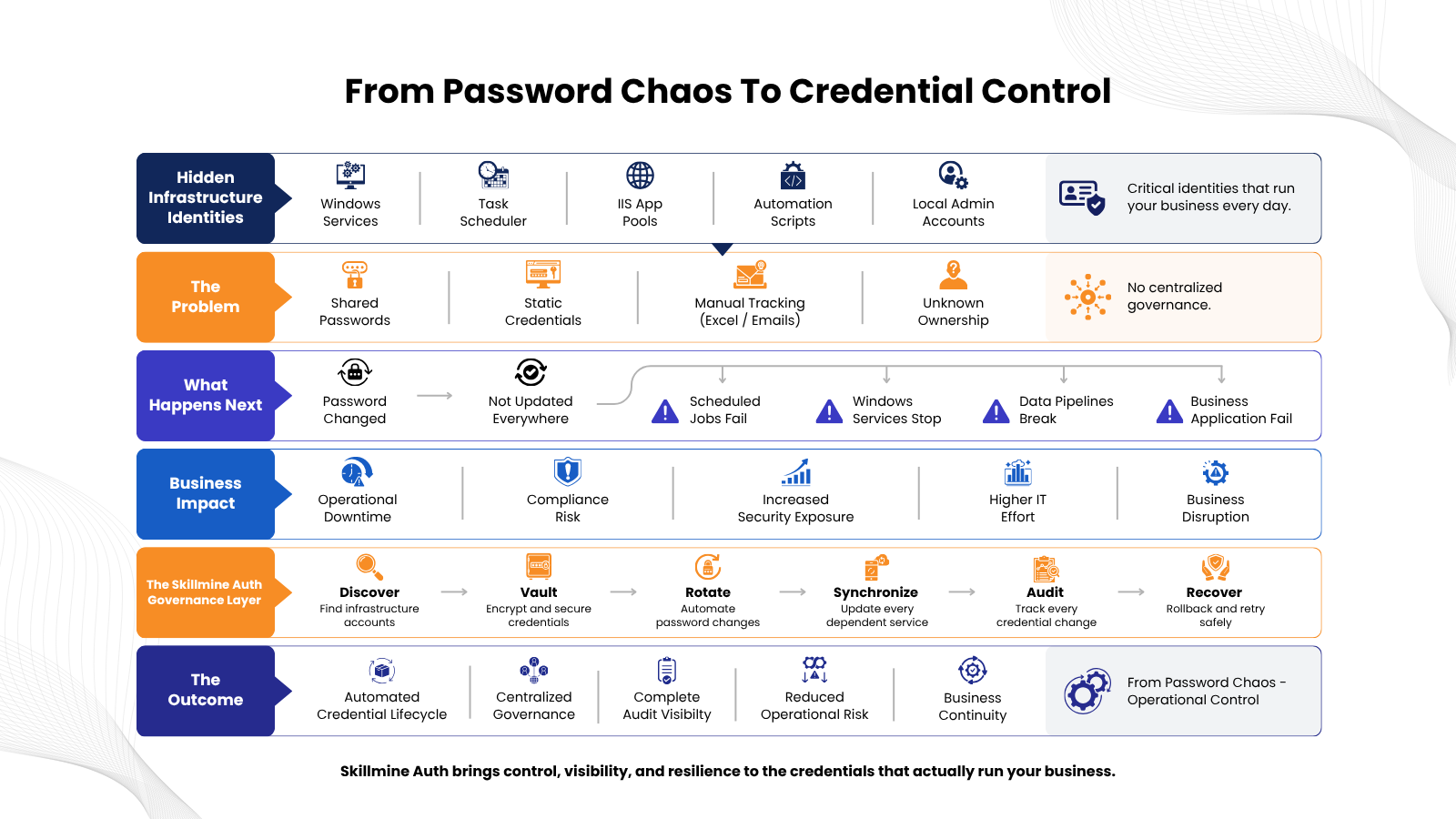
These accounts power critical operations through:
- Windows Services
- Task Scheduler jobs
- IIS Application Pools
- Batch processes and automation scripts
- Local administrator and system accounts
They keep businesses running every day, but in many environments they remain unmanaged, making them one of the weakest links in enterprise security.
Infrastructure credentials are rarely governed like user accounts, especially in distributed or non-Active Directory environments.
As a result, organizations often deal with credentials that are:
- Shared across multiple systems
- Left unchanged for months or even years
- Tracked manually through spreadsheets or emails
- Missing clear ownership
This is not an exception. It is how many operational environments function today.
Static or shared passwords increase exposure and reduce organizational control over privileged credentials.
Manual password rotation often leads to service interruptions and operational failures when updates are missed or applied inconsistently.
The absence of an audit trail weakens compliance by making it difficult to track credential ownership, usage, and changes.
When one account is used across multiple systems, a single password change can disrupt several services and business-critical workloads if credentials are not updated everywhere.
The challenge often appears as an operational outage before it is recognized as a security issue.
Where the Problem Shows Up
Credential governance failures rarely trigger immediate security alerts.
Instead, they surface through business disruptions such as:
- Scheduled jobs failing after a password update
- Services stopping because credentials are no longer synchronized
- Overnight business workflows breaking without warning
When IT teams begin investigating, they often struggle to answer critical questions:
- Who owns this account?
- Where is it being used?
- When was the password last rotated?
Without centralized visibility, these answers are often incomplete or unavailable.
A shared service account password is updated.
One dependent system is overlooked during the update.
By the next morning:
- Scheduled jobs fail
- Data pipelines stop processing
- Reports are not generated
The business impact is already significant before the root cause is identified.
This is not an isolated incident. It is the result of weak credential governance.
Modern IT environments are becoming increasingly complex.
Several factors are driving the rise of unmanaged infrastructure identities:
- Growing automation creates more service accounts.
- Hybrid infrastructures reduce centralized visibility.
- Legacy applications continue to operate alongside modern systems.
- Compliance expectations under standards such as ISO and SOC 2 continue to increase.
The number of non-human identities is expanding much faster than the governance mechanisms designed to manage them.
Many organizations operate environments where Active Directory coverage is limited or unavailable.
Even where AD exists, it often does not fully cover:
- Distributed locations
- Legacy systems
- Isolated servers
- Newly acquired environments
These environments frequently carry the highest credential risk.
Skillmine Auth operates independently of Active Directory, making it well suited for:
- Hybrid infrastructures
- Non-domain systems
- Rapid deployments without heavy infrastructure dependencies
Traditional approaches solve only part of the problem.
- Password vaults secure storage but do not manage credential lifecycles.
- Privileged Access Management solutions can be complex and primarily focus on user access.
- Custom scripts are difficult to maintain, lack scalability, and provide little auditability.
- Active Directory alone cannot govern every infrastructure identity.
The missing layer is centralized governance for non-human identities.
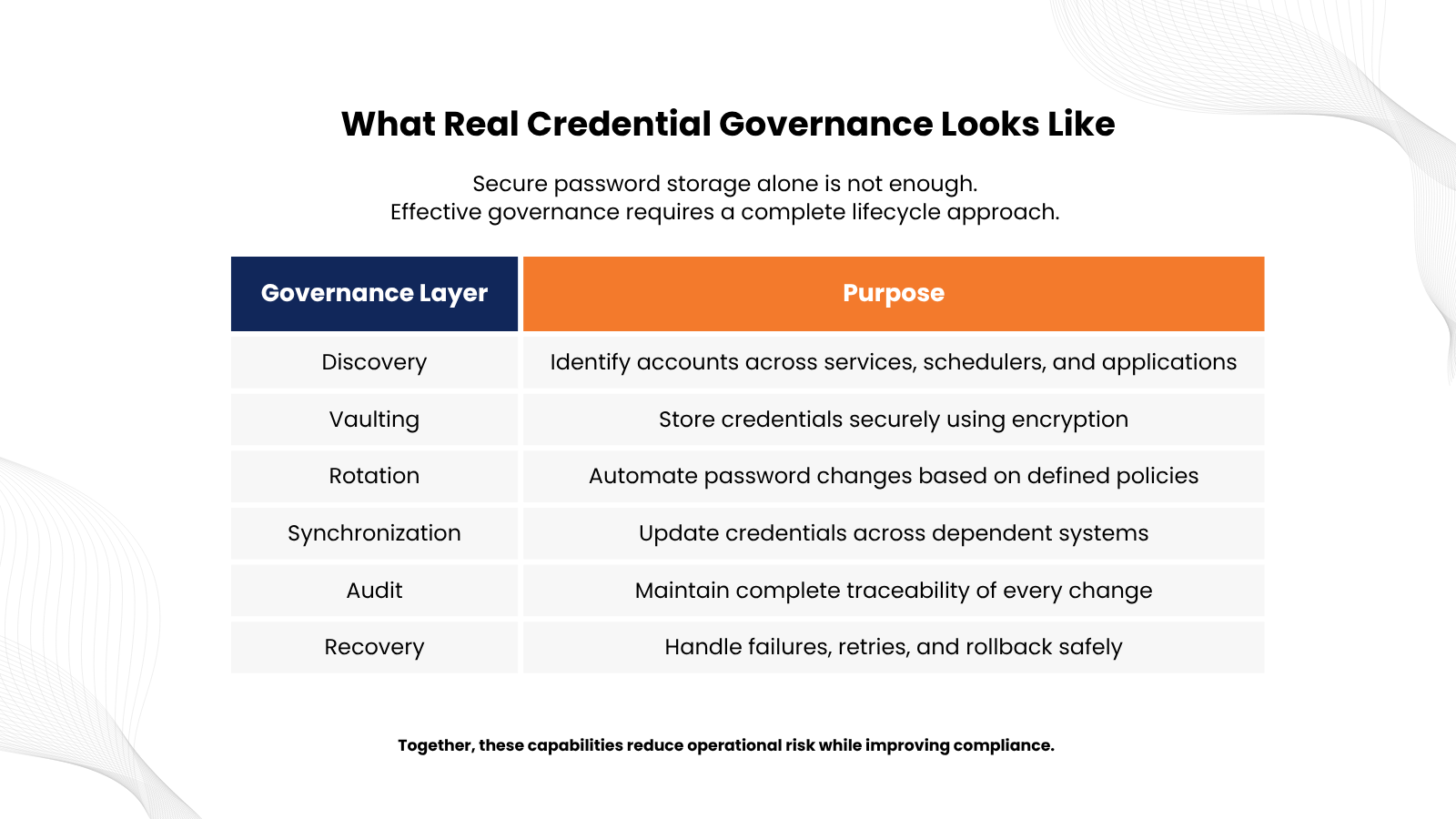
Skillmine Auth delivers that layer through centralized credential governance, encrypted vaulting, automated password rotation, secure credential distribution, synchronization across dependent systems, complete audit traceability, controlled privileged access, and operational visibility.
Its objective goes beyond password rotation. It helps prevent hidden failures, reduce manual effort, and provide a single point of control for credentials that are otherwise scattered across the infrastructure.
Business Impact
Effective infrastructure credential governance delivers measurable value across the organization.
- For CISOs: Reduced risk from unmanaged privileged accounts.
- For IT leaders: Lower manual credential maintenance and fewer service disruptions.
- For Audit Teams: Improved traceability and stronger compliance evidence.
- For Business Leaders: Greater operational resilience with fewer costly outages.
This is not only about strengthening security. It is about protecting business operations.
Identity has become the new security perimeter, but most organizations still focus primarily on user accounts.
The greater challenge lies in governing the non-human identities that keep critical infrastructure running.
If your infrastructure credentials are:
- Static
- Shared
- Invisible
Then your organization lacks true control.
Skillmine Auth transforms infrastructure identity management by delivering centralized governance, visibility, automation, and resilience without requiring a complex Active Directory deployment.
That is how organizations eliminate password chaos and enforce control without complexity.