Table of Contents
- The Shift: From Cloud Adoption to Cloud Accountability
- What FinOps Really Means for Cloud Engineering
- The Rise of AI-Driven FinOps
- Why Traditional Cloud Engineering Models Are Failing
- Engineering FinOps Into Cloud Architecture
- The Skillmine Perspective: Engineering Cloud with Financial Intelligence
- Conclusion
Cloud adoption has entered a new phase. What began as a scalability and agility play has now evolved into a cost accountability challenge. Enterprises are no longer asking how fast they can move to the cloud but how efficiently they can operate within it.
Recent industry data highlights a sharp reality. Nearly 94% of IT decision-makers struggle with managing cloud costs, while cloud waste has risen to 29% in 2026, driven largely by AI workloads and multi-cloud complexity . At the same time, organizations are allocating up to 41% of IT budgets toward cloud infrastructure, signaling both dependence and risk .
This is where FinOps is no longer a financial practice. It is a cloud engineering discipline.
The Shift: From Cloud Adoption to Cloud Accountability
For years, cloud engineering focused on performance, uptime, and scalability. Cost was treated as a post-facto metric, reviewed after deployment cycles.
That model is breaking.
Modern cloud environments are:
- Multi-cloud by default
- AI workload intensive
- Dynamically scaling in real time
- Consumed across distributed teams
As a result, cost is no longer a billing output. It is a design variable.
Industry reports now show that only 43% of organizations track cloud costs at a granular level, while many exceed $1 million in monthly SaaS or cloud spend without clear attribution .
This gap between engineering decisions and financial outcomes is exactly what FinOps aims to close.
What FinOps Really Means for Cloud Engineering
FinOps, or Cloud Financial Operations, is often misunderstood as cost optimization. In reality, it is a cross-functional operating model that integrates finance, engineering, and business teams into a shared accountability framework.
At its core, FinOps transforms cloud engineering across three dimensions:
- Real-Time Cost Visibility
Engineers no longer deploy blindly. Every workload, container, or API call is tied to cost metrics in real time.
- Unit Economics Integration
Cloud cost is measured per transaction, per user, or per feature, not just as a monthly bill. This enables direct alignment between engineering output and business value.
- Continuous Optimization Loops
Optimization is no longer periodic. It is embedded into CI/CD pipelines, infrastructure provisioning, and runtime monitoring.
This shift is critical because 82% of organizations report at least 10% cloud spend waste, largely due to over-provisioning and idle resources .
The Rise of AI-Driven FinOps
One of the most defining trends in 2025–2026 is the emergence of AI-native FinOps.
More than 60% of enterprises are already using AI or automation in FinOps workflows, with capabilities such as:
- Predictive cost forecasting
- Automated anomaly detection
- Dynamic resource right-sizing
AI models are now capable of reducing cloud spend by 30–40% through intelligent allocation strategies .
However, AI is also a double-edged sword.
As organizations scale AI workloads:
- Compute demand increases exponentially
- Storage and data transfer costs spike
- Training models introduce unpredictable cost patterns
This has directly contributed to rising cloud waste and financial unpredictability .
The implication is clear: AI cannot scale without FinOps.
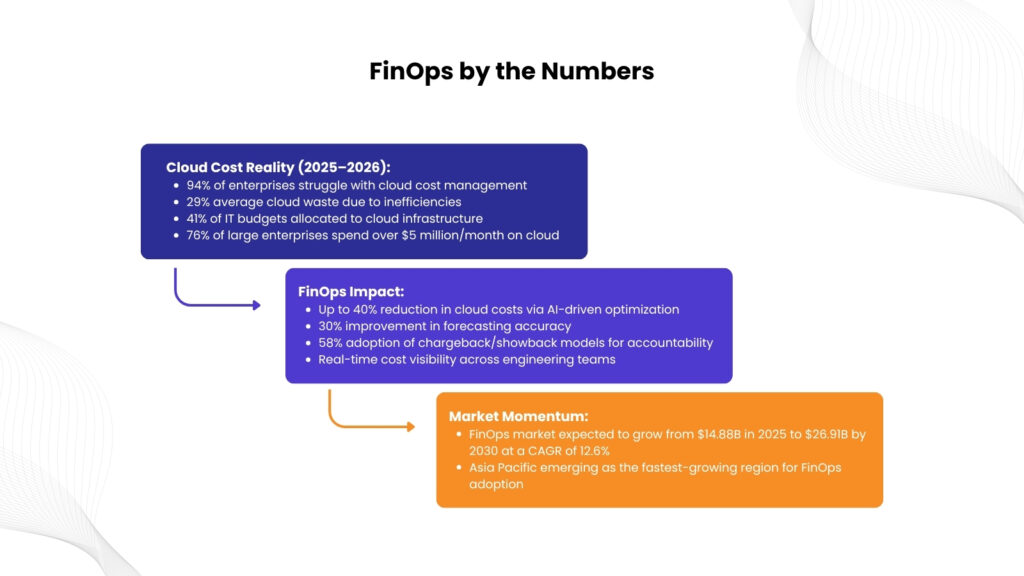
Cloud Cost Reality (2025–2026):
- 94% of enterprises struggle with cloud cost management
- 29% average cloud waste due to inefficiencies
- 41% of IT budgets allocated to cloud infrastructure
- 76% of large enterprises spend over $5 million/month on cloud
FinOps Impact:
- Up to 40% reduction in cloud costs via AI-driven optimization
- 30% improvement in forecasting accuracy
- 58% adoption of chargeback/showback models for accountability
- Real-time cost visibility across engineering teams
Market Momentum:
- FinOps market expected to grow from $14.88B in 2025 to $26.91B by 2030 at a CAGR of 12.6%
- Asia Pacific emerging as the fastest-growing region for FinOps adoption
Why Traditional Cloud Engineering Models Are Failing
Despite investments in cloud platforms, many organizations are still unable to control costs effectively. The root causes are structural:
- Lack of Cost Ownership
Engineering teams optimize for performance, not cost, because financial accountability is not embedded in workflows.
- Fragmented Multi-Cloud Environments
Different billing models across providers create visibility gaps and inconsistent governance.
- Reactive Cost Management
Most organizations still analyze costs after consumption rather than during architecture design.
- Absence of Governance at Scale
Even though FinOps adoption is increasing, governance frameworks are still immature or siloed.
The FinOps Foundation’s latest insights show that governance and policy implementation at scale is now the top priority for enterprises, surpassing even workload optimization .
Engineering FinOps Into Cloud Architecture
To move beyond cost chaos, FinOps must be embedded into the cloud engineering lifecycle itself.
- Design for Cost Efficiency
- Use right-sizing and autoscaling from the architecture stage
- Select storage and compute based on workload patterns
- Evaluate cost-performance trade-offs upfront
- Implement Unified Cost Data Models
Frameworks like FOCUS (FinOps Open Cost and Usage Specification) are enabling standardized cost visibility across SaaS, PaaS, and IaaS environments .
- Shift Left on Cost Governance
Cost controls must be integrated into:
- DevOps pipelines
- Infrastructure as Code (IaC)
- Deployment approvals
- Enable Cross-Functional Collaboration
FinOps teams must include:
- Cloud engineers
- Finance leaders
- Product stakeholders
This ensures decisions are aligned with both technical feasibility and financial outcomes.
The APAC Perspective: A High-Growth FinOps Market
The Asia Pacific region is rapidly emerging as a FinOps leader, driven by:
- Government-led cloud initiatives in India, Japan, and Australia
- Large-scale SaaS adoption
- Rapid digital transformation across BFSI and public sector
APAC is expected to witness the highest growth rate in the FinOps market globally, as enterprises enforce stricter cloud budgeting and governance frameworks .
This shift indicates a broader trend:
Cloud maturity is now measured by financial discipline, not just adoption.
The Skillmine Perspective: Engineering Cloud with Financial Intelligence
At Skillmine, cloud engineering is not treated as infrastructure deployment. It is approached as a business-aligned, cost-intelligent ecosystem.
Skillmine enables enterprises to:
- Embed FinOps into cloud architecture from day one
- Implement real-time cost visibility across multi-cloud environments
- Leverage AI-driven optimization for continuous cost control
- Build governance frameworks that scale with business growth
This ensures that cloud is not just scalable, but sustainable.
Conclusion
The cloud conversation has fundamentally changed.
Enterprises are no longer judged by how quickly they migrate, but by how efficiently they operate. FinOps represents this evolution, where engineering decisions are directly tied to financial outcomes.
In this new reality, cloud engineering without FinOps is incomplete.
The organizations that succeed will be those that:
- Treat cost as a design parameter
- Integrate finance into engineering workflows
- Use AI not just to scale, but to optimize
Because in the modern enterprise, every line of code has a cost, and every cost must deliver value.