Artificial Intelligence has moved from experimentation to expectation. Over the past two years, enterprises have aggressively adopted AI tools across functions ranging from customer service to software development. However, beneath this rapid adoption lies a critical gap.
Most organizations are using AI. Very few are engineering it.
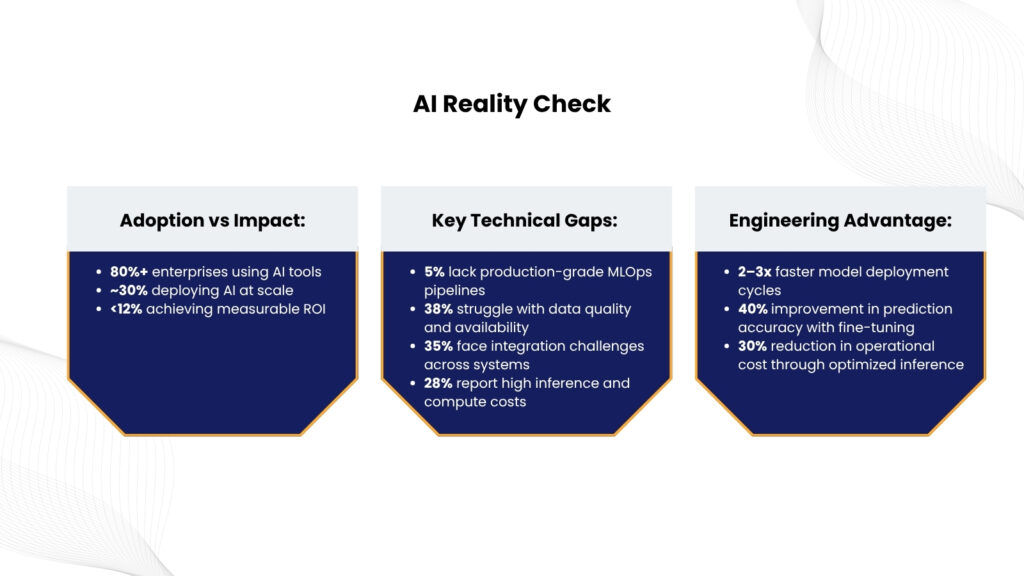
Recent industry data indicates that while over 80% of enterprises have integrated AI into at least one business function, less than 30% have operationalized AI at scale, and fewer than 12% report measurable ROI from AI initiatives.
This gap is not a tooling problem. It is an engineering maturity problem.
AI is no longer a feature layer. It is becoming a core architectural component, and enterprises that fail to treat it as such will struggle to scale beyond isolated use cases.
The Shift: From AI Tools to AI Systems
The current wave of AI adoption is largely driven by accessible tools such as large language models, copilots, and automation platforms. While these tools accelerate experimentation, they also create an illusion of capability.
Using AI tools is not equivalent to building AI systems.
AI engineering requires:
- Designing data pipelines that continuously feed models
- Building model orchestration layers across workflows
- Managing inference latency and compute efficiency
- Ensuring reproducibility, monitoring, and governance
Without these foundational layers, AI remains a disconnected utility rather than an integrated capability.
This is why a majority of AI initiatives fail to move beyond pilot stages.
Understanding the AI Maturity Gap
Enterprises today broadly fall into three categories:
1. AI Consumers
Organizations leveraging third-party tools for productivity gains without deep integration into core systems.
2. AI Integrators
Teams embedding AI into workflows but relying heavily on external APIs and limited customization.
3. AI Engineers
Organizations building, fine-tuning, and orchestrating AI models as part of their core architecture.
The competitive advantage is shifting rapidly toward the third category.
This is reinforced by industry trends showing that organizations with in-house AI engineering capabilities achieve up to 3x higher ROI on AI investments, primarily due to better alignment with business workflows and data ecosystems.
The Rise of AI Engineering as a Discipline
AI engineering is emerging as a distinct domain that sits at the intersection of software engineering, data science, and cloud architecture.
It introduces a structured approach to building and scaling AI systems through:
1. MLOps and Lifecycle Management
AI models are no longer static artifacts. They require:
- Continuous training and retraining pipelines
- Version control for models and datasets
- Automated testing and validation frameworks
MLOps ensures that models remain reliable and performant in production environments.
2. Data Engineering at Scale
AI performance is directly tied to data quality. This requires:
- Real-time data ingestion pipelines
- Data cleaning and transformation layers
- Feature engineering and feature stores
Without robust data engineering, even the most advanced models fail to deliver value.
3. Model Optimization and Fine-Tuning
Pre-trained models provide a starting point, but enterprise use cases demand:
- Domain-specific fine-tuning
- Parameter-efficient training techniques
- Latency and cost optimization during inference
This is particularly critical as large models introduce significant compute overhead.
4. AI Infrastructure and Compute Strategy
AI workloads demand specialized infrastructure:
- GPU/TPU orchestration
- Distributed training environments
- Scalable inference endpoints
Engineering teams must balance performance with cost efficiency, especially as AI workloads scale.
The Cost and Complexity of Scaling AI
While AI unlocks new capabilities, it also introduces operational complexity.
Recent trends highlight that:
- AI workloads can increase cloud costs by 20–35% due to compute-intensive processes
- Inference costs often exceed training costs at scale
- Poorly optimized models lead to significant latency and user experience issues
This creates a dual challenge:
- Technical scalability
- Financial sustainability
Organizations that fail to optimize both will face diminishing returns on AI investments.
Why Most AI Initiatives Stall
Despite strong intent, many enterprises struggle to scale AI due to systemic issues:
1. Fragmented Data Ecosystems
Data is often distributed across multiple systems without a unified architecture.
2. Lack of Engineering Ownership
AI initiatives are frequently led by data science teams without deep integration into engineering workflows.
3. Over-Reliance on External Tools
While tools accelerate adoption, they limit customization and long-term scalability.
4. Absence of Governance Frameworks
AI introduces risks related to bias, compliance, and explainability, which require structured governance. Without addressing these challenges, AI remains experimental rather than operational.
Engineering AI into the Enterprise Stack
To unlock real value, AI must be embedded into the enterprise architecture rather than layered on top.
1. Integrate AI into Core Workflows
AI should augment decision-making across systems such as CRM, ERP, and supply chain platforms.
2. Build Modular AI Architectures
Use microservices and APIs to enable flexible model deployment and integration.
3. Optimize for Real-Time Inference
Low-latency systems are critical for customer-facing and operational use cases.
4. Establish AI Governance
Implement frameworks for:
- Model explainability
- Data privacy and compliance
- Bias detection and mitigation
This ensures responsible and scalable AI deployment.
The Convergence of AI, Cloud, and Data
AI engineering does not exist in isolation. It is deeply interconnected with cloud and data ecosystems.
Modern AI architectures rely on:
- Cloud-native infrastructure for scalability
- Data lakes and warehouses for unified data access
- Event-driven systems for real-time processing
This convergence is redefining enterprise architecture, where AI becomes a first-class citizen rather than an add-on capability.
The Skillmine Perspective: Engineering AI, Not Just Using It
At Skillmine, AI is approached as an engineering discipline, not a toolset.
Skillmine enables enterprises to:
- Build production-grade AI systems with robust MLOps pipelines
- Integrate AI seamlessly into business workflows and applications
- Optimize models for performance, scalability, and cost efficiency
- Establish governance frameworks for responsible AI deployment
This ensures that AI initiatives move beyond experimentation and deliver measurable business outcomes.
Conclusion
The enterprise AI journey is at an inflection point. Adoption alone is no longer enough. The competitive advantage lies in how well AI is engineered, integrated, and scaled.
Organizations that continue to rely solely on AI tools will face limitations in customization, performance, and ROI. In contrast, those that invest in AI engineering will unlock sustained value and differentiation.
In the evolving digital landscape, AI is not just a capability. It is infrastructure. And like any critical infrastructure, it must be designed, built, and optimized with precision.