The Shift Redefining Banking Security
Across the global financial ecosystem, cybersecurity is undergoing a fundamental transformation. Nowhere is this shift more visible than in APAC, where banks are rapidly moving from compliance-driven security models to cyber resilience strategies that prioritize adaptability, response, and continuity.
New Zealand, while smaller in scale compared to markets like India or Australia, offers a powerful lens into this transformation. With high digital adoption, a connected financial ecosystem, and increasing exposure to cyber threats, the country is becoming a case study in modern banking security evolution.
For financial institutions across APAC, the message is becoming increasingly clear: meeting compliance standards is no longer enough to ensure security or trust.
A Data-Backed Wake-Up Call
New Zealand’s cybersecurity landscape reflects a growing global reality where financial risk and cyber risk are deeply intertwined.
Recent data highlights the urgency:
- Over 1,100+ cyber incidents reported within a single quarter, indicating a sustained attack frequency
- Estimated annual scam-related losses approaching NZD 200 million, with both individuals and institutions affected
- A significant portion of the population experiencing cyber scams, with many incidents resulting in financial loss
- Increasing cases of unauthorized access, credential theft, and phishing-based fraud targeting banking customers
These numbers point to a systemic issue. Cyberattacks are no longer isolated disruptions; they are continuous, financially motivated, and increasingly sophisticated. For banks, this translates into not just operational risk but also reputational damage and erosion of customer trust.
From Compliance to Cyber Resilience: What’s Really Changing
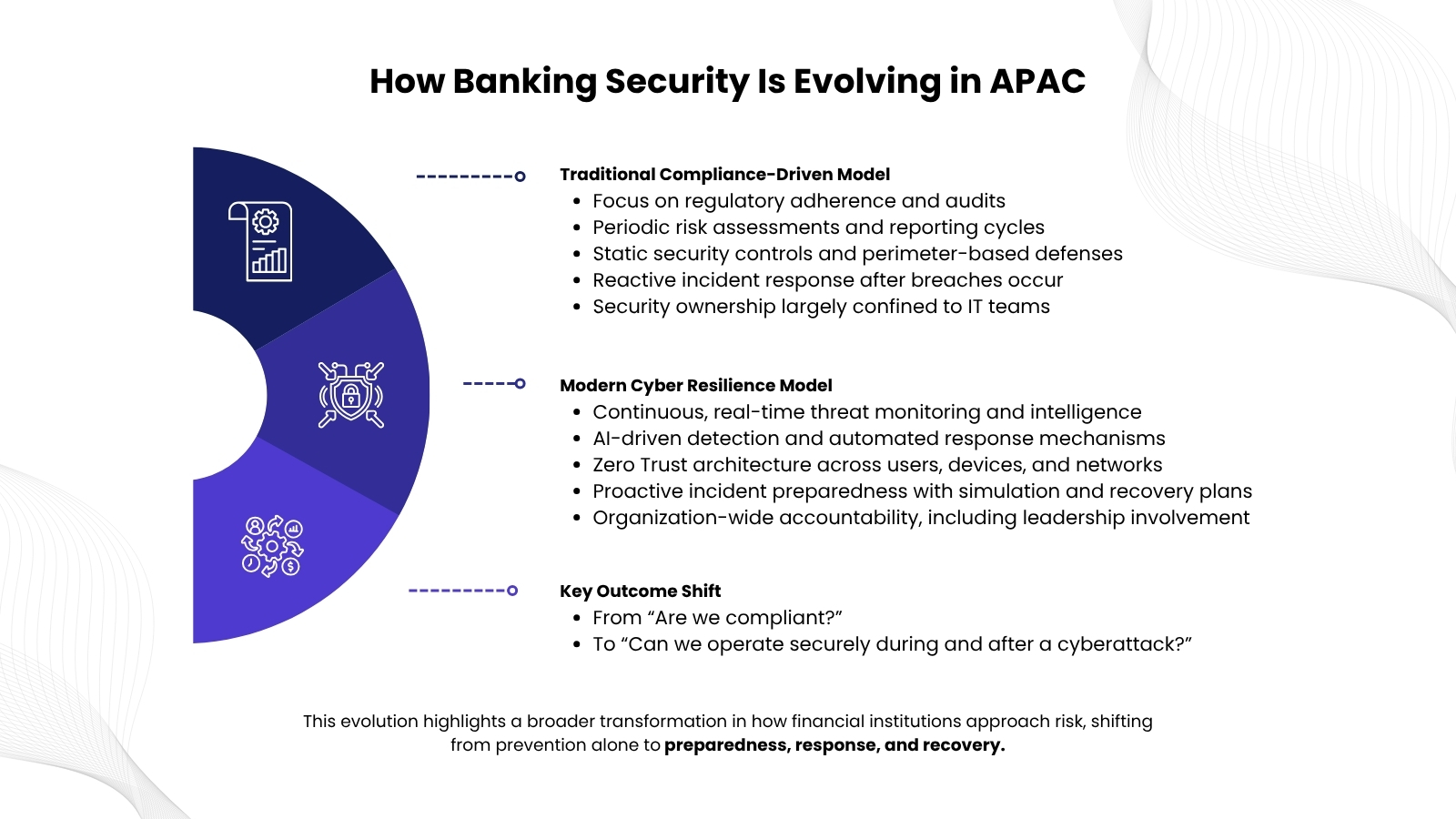
Traditionally, banking security frameworks were built around regulatory compliance. Institutions focused on audits, controls, and periodic risk assessments to demonstrate adherence to standards. However, the modern threat landscape has exposed the limitations of this approach. Today’s cyber threats are:
- Persistent rather than episodic
- Adaptive, often leveraging AI and automation
- Targeted, focusing on both systems and human vulnerabilities
As a result, regulators and financial institutions are shifting toward a resilience-first mindset. This includes:
- Continuous monitoring instead of periodic reviews
- Real-time threat detection and response capabilities
- Stronger governance around AI and digital risks
- Greater accountability at the leadership and board level
In this new paradigm, compliance is treated as a baseline requirement, while resilience becomes the defining capability.
Why New Zealand Is a Preview of APAC’s Future
New Zealand’s banking ecosystem reflects several trends that are rapidly emerging across APAC, making it a valuable indicator of what lies ahead.
High Digital Banking Penetration
With widespread adoption of digital banking and online financial services, the attack surface has expanded significantly. Increased connectivity between platforms, APIs, and third-party services introduces new vulnerabilities that traditional security models struggle to address.
Rising Sophistication of Cyber Threats
Escalating Financial Impact
Even when breaches are detected and contained, the associated costs continue to rise. These include direct financial losses, regulatory penalties, operational disruptions, and long-term reputational damage.
Growing Focus on Systemic Risk
Governments and regulators are increasingly recognizing cybersecurity as a matter of national and financial stability. This has led to stricter oversight, enhanced reporting requirements, and a stronger emphasis on resilience planning.
The Bigger Picture: Cyber Resilience as a Business Imperative
The shift toward cyber resilience is not just a technological evolution. It represents a broader change in how banks define success and manage risk.
Financial institutions are now evaluated on their ability to:
- Protect customer data and assets in real time
- Prevent and mitigate fraud effectively
- Maintain operational continuity during disruptions
- Respond swiftly to emerging threats
- Build and sustain customer trust
In this context, cybersecurity becomes a core business function, directly influencing growth, reputation, and competitive advantage.
Resilience Is the New Standard
New Zealand’s experience underscores a critical reality for banks across APAC. As cyber threats become more frequent and sophisticated, traditional compliance-driven approaches are no longer sufficient.
The future of banking security lies in cyber resilience, the ability to anticipate, withstand, and recover from attacks while continuing to deliver value to customers.
For organizations that embrace this shift, resilience will not just be a defense mechanism. It will become a strategic differentiator.