
Hybrid cloud was never meant to be complicated. It was meant to offer flexibility. The ability to balance control and scalability. To run critical workloads where they perform best, while still enabling innovation at speed. But for many enterprises, hybrid cloud has evolved into something else entirely. A patchwork.
Different environments stitched together over time. Multiple cloud providers, legacy systems, on-prem infrastructure, and third-party services, all coexisting, but not necessarily aligned. Individually, they work. Collectively, they struggle. The real challenge is not adopting hybrid cloud. It is making it cohesive.
Most hybrid cloud environments are not designed in one go. They evolve.
- A business unit adopts a public cloud provider
- Another retains on-prem systems for compliance or control
- New tools are layered in to solve immediate problems
- Integrations are added incrementally
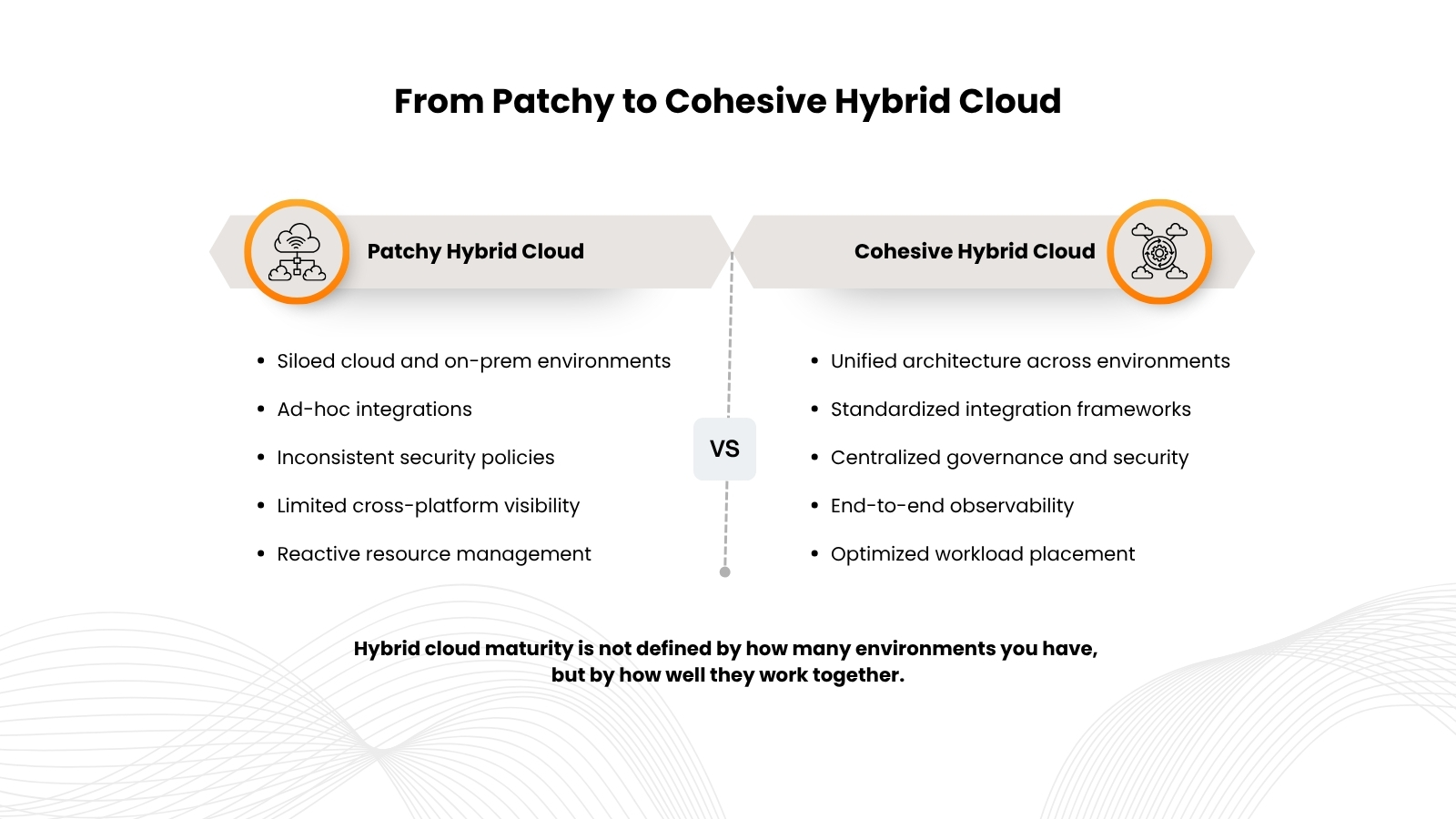
Over time, this creates an ecosystem that is technically functional, but strategically inconsistent. You end up with:
- Disconnected workloads across environments
- Inconsistent security and governance models
- Limited visibility across systems
- Redundant costs and underutilized resources
This is what “patchy” looks like. Not broken, but far from optimized.
Fragmentation does not always show up as failure. It shows up as friction.
- Teams spend more time managing environments than innovating
- Data movement becomes complex and inefficient
- Performance varies across workloads
- Security risks increase due to inconsistent controls
Most importantly, decision-making slows down. Because when systems are not aligned, neither are the insights they generate. At this point, hybrid cloud stops being an advantage and starts becoming an operational burden.
A cohesive hybrid cloud strategy is not about reducing environments. It is about connecting them with intent. It ensures that:
- Workloads are placed based on business needs, not convenience
- Data flows seamlessly across systems
- Security and governance are consistent across environments
- Teams operate with a unified view of infrastructure
Cohesion is what turns hybrid cloud from a setup into a strategy.
Creating a cohesive hybrid cloud strategy does not require starting from scratch. It requires realignment.
1. Define a Clear Architecture Layer
Hybrid environments often lack a unifying architectural blueprint. Establishing clear principles around:
- Workload placement
- Integration standards
- Data flow
creates a foundation that brings consistency across systems.
2. Standardize Integration, Not Just Infrastructure
Many organizations focus on infrastructure optimization but overlook integration. Without standardized APIs, middleware, and communication layers, systems remain disconnected. Integration is what enables hybrid environments to function as one.
3. Bring Governance to the Center
Security, compliance, and access control should not vary across environments. A cohesive strategy requires:
- Unified identity and access management
- Consistent policy enforcement
- Centralized monitoring
Governance ensures that flexibility does not compromise control.
4. Invest in Observability Across the Stack
Visibility is often fragmented in hybrid setups. Enterprises need:
- Real-time insights across cloud and on-prem systems
- Unified monitoring dashboards
- Clear mapping of dependencies and performance metrics
Observability turns complexity into actionable intelligence.
5. Align Cloud Strategy with Business Priorities
Hybrid cloud decisions should not be driven solely by technology. They must align with:
- Business goals
- Performance requirements
- Cost optimization strategies
This ensures that infrastructure supports outcomes, not just operations.
When hybrid cloud becomes cohesive, the impact is immediate.
- Faster deployment cycles
- Improved system reliability
- Better cost efficiency
- Stronger security posture
- More confident decision-making
More importantly, it allows enterprises to shift focus. From managing environments to leveraging them.
Many organizations are already operating in hybrid cloud environments. The next phase is not expansion. It is optimization.
This means moving beyond:
- Adding more tools
- Expanding into more platforms
And focusing instead on:
- Alignment
- Integration
- Governance
Because the value of hybrid cloud is not in its diversity. It is in its cohesion.
Hybrid cloud is not inherently complex. It becomes complex when it evolves without structure. The difference between a patchy environment and a powerful one lies in how intentionally it is designed, connected, and governed. Because in the end, hybrid cloud is not about where your systems run. It is about how well they work together.
Move from fragmented cloud environments to a truly connected strategy. Discover how Skillmine helps enterprises design cohesive hybrid cloud architectures that are scalable, secure, and aligned to business outcomes