AI has moved beyond experimentation.
What was once limited to pilots and proofs of concept is now deeply embedded in decision-making, operations, and customer experience. Enterprises are no longer asking if they should adopt AI, but how fast they can scale it. And yet, a critical gap persists. Most organizations are investing heavily in AI capabilities while treating governance as an afterthought, something to be layered on later, often under pressure. That approach no longer works. In the AI era, governance is not a constraint. It is the very foundation that determines whether AI scales, sustains, and delivers real business value.
The Shift: From Control to Enablement
Traditionally, governance has been associated with control, compliance, and risk mitigation. It was seen as a necessary overhead, something that slows innovation but protects the organization. AI changes that equation. When systems begin to make decisions, learn from data, and operate at scale, the absence of governance doesn’t accelerate progress, it introduces uncertainty.
- Can the outputs be trusted?
- Is the data reliable and compliant?
- Are decisions explainable and auditable?
Without clear answers, AI initiatives stall. Not because of technical limitations, but because of a lack of confidence. This is where governance evolves. It moves from being a control mechanism to becoming an enabler of trust, and trust is what allows AI to scale across the enterprise.
Why AI Without Governance Fails to Scale
Many enterprises experience early success with AI. A model performs well in a controlled environment. A use case delivers measurable impact. But as they attempt to scale, complexity increases rapidly. Data sources multiply. Models evolve. Regulations tighten. Stakeholders expand. Without governance, this complexity leads to fragmentation.
- Multiple versions of the same model with no clear ownership
- Inconsistent data definitions across teams
- Limited visibility into how decisions are being made
- Increased exposure to compliance and reputational risks
At this stage, AI doesn’t fail technically. It fails operationally. Scaling AI requires more than infrastructure and models. It requires structure, accountability, and alignment.
The Three Pillars of AI Governance
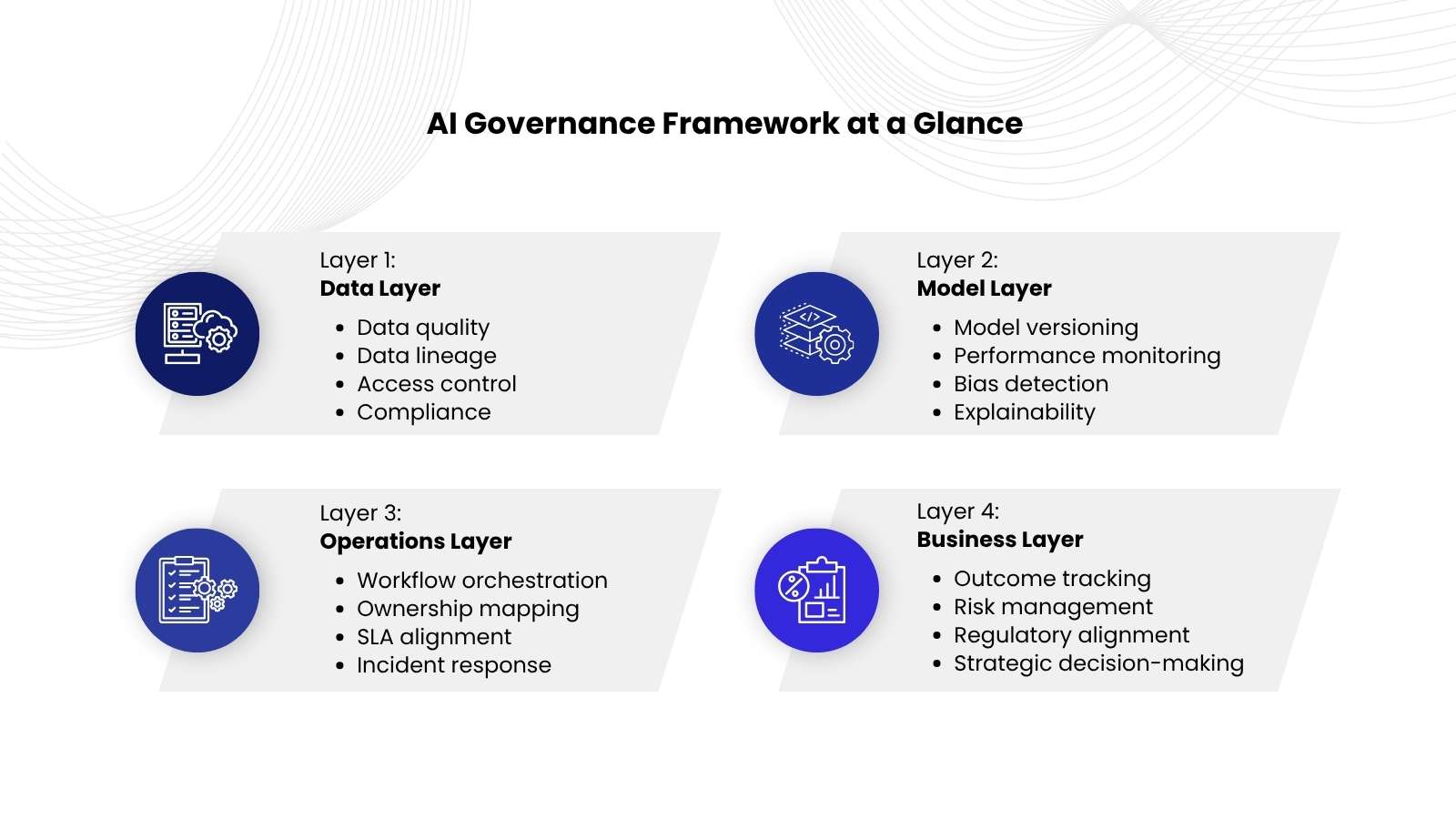
To move from fragmented AI initiatives to enterprise-wide impact, governance must be built on three core pillars:
1. Data Governance: The Foundation of Trust
AI systems are only as reliable as the data they are built on. This means:
- Ensuring data quality, consistency, and lineage
- Defining ownership and access controls
- Maintaining compliance with evolving regulations
When data is governed effectively, it creates a single source of truth, reducing ambiguity and increasing confidence in outcomes.
2. Model Governance: Managing the Lifecycle
AI models are not static. They evolve, degrade, and adapt over time. Governance here focuses on:
- Version control and model traceability
- Performance monitoring and drift detection
- Explainability and auditability
Without this, organizations risk deploying models that no longer reflect reality, or worse, introduce bias and inaccuracies.
3. Operational Governance: Driving Accountability
AI does not operate in isolation. It interacts with systems, processes, and people. Operational governance ensures:
- Clear ownership across teams
- Defined workflows for deployment and monitoring
- Alignment between business objectives and AI outcomes
This is what transforms AI from isolated experiments into integrated business capabilities.
From Risk Management to Growth Acceleration
When implemented correctly, governance does more than reduce risk. It accelerates growth.
With the right frameworks in place:
- AI initiatives move faster from pilot to production
- Decision-making becomes more reliable and scalable
- Regulatory compliance becomes proactive, not reactive
- Cross-functional alignment improves significantly
Most importantly, governance builds organizational confidence in AI. And confidence is what unlocks investment, adoption, and long-term value.
The Competitive Advantage of Getting Governance Right
As AI adoption increases, the gap between organizations that can scale responsibly and those that cannot will widen. The differentiator will not be who has access to better algorithms. It will be who has the ability to operate AI systems with clarity, control, and trust at scale. Governance becomes the invisible infrastructure that supports everything else. Without it, growth is unstable. With it, growth is repeatable.
Conclusion: Governance Is the Strategy
Turn governance into a growth enabler, not a bottleneck. Explore how Skillmine helps enterprises build scalable, AI-ready governance frameworks