For years, artificial intelligence initiatives were justified primarily through cost reduction. Automation minimized manual effort. Chatbots reduced service overheads. Predictive systems optimized supply chains and lowered operational waste. The return was visible, measurable and financially defensible.
In 2026, that definition of ROI is no longer sufficient.
Enterprises that have embedded AI into their operating models now understand that cost savings represent only the surface layer of value. The deeper return lies in how AI strengthens decision-making, enhances resilience, accelerates innovation and augments human capability. The conversation has shifted from efficiency to enablement.
AI is no longer a pilot project. It is foundational infrastructure. As a result, the way organizations measure its impact must evolve.
Early adoption focused on eliminating repetitive tasks and reducing operational friction. That phase delivered quick wins. However, AI today influences product strategy, cybersecurity posture, compliance management, customer experience and enterprise analytics. It shapes pricing models, forecasts demand shifts and supports executive planning.
Leaders are therefore asking more expansive questions. Has AI improved decision quality? Has it reduced systemic risk exposure? Has it accelerated innovation cycles? Has it unlocked new growth opportunities?
Cost efficiency is now the baseline. Strategic impact is the true differentiator.
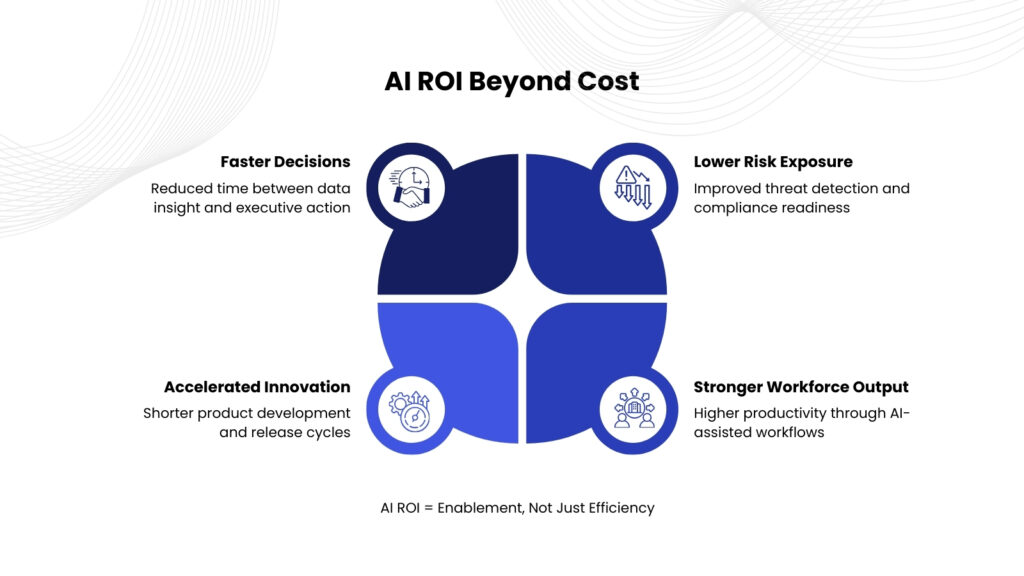
Reduction in decision cycle time, faster forecasting adjustments and real-time operational visibility are becoming critical indicators of AI maturity. These gains may not always show up as direct savings, yet they influence market positioning and strategic timing.
Speed is no longer convenience. It is advantage.
AI now plays a central role in identifying anomalies, fraud patterns, compliance gaps and cyber threats. Rather than reacting to incidents, enterprises increasingly rely on predictive detection systems.
Return on investment is measured through avoided losses, reduced incident impact and improved audit readiness. In regulated industries especially, AI-driven risk intelligence directly influences reputation, governance maturity and long-term stability.
These outcomes may not always appear as traditional cost savings, yet they protect enterprise value at scale.
Generative AI and predictive analytics are reshaping research, engineering and product development. AI-assisted environments reduce backlogs, enhance quality and shorten release cycles.
Time-to-market reduction and improved iteration speed contribute directly to competitive positioning. AI shortens innovation loops and enables teams to test and deploy more rapidly.
Traditional ROI models struggle to quantify this compounding effect. However, innovation velocity increasingly serves as a strategic indicator of AI value.
Mature organizations are not focused on replacing talent. They are focused on amplifying it. AI enhances productivity, surfaces deeper insights and reduces cognitive overload.
Leaders now measure output per employee, AI adoption rates across departments and improvements in digital fluency. Human capability upliftment is becoming a core dimension of return.
AI ROI includes performance enhancement, not just cost containment.
Conventional ROI frameworks prioritize tangible financial offsets. While important, they overlook compound value creation. Faster decisions can secure market share. Stronger risk detection can prevent regulatory penalties. Intelligent personalization can increase lifetime customer value. Enhanced data visibility can enable strategic pivots.
These shifts reshape enterprise trajectory over time. They may not always register as immediate savings, but they influence long-term growth and resilience.
Organizations that restrict AI evaluation to finance-only metrics risk underinvesting in transformative capabilities.
AI is no longer experimental. It is embedded within enterprise architecture. It informs operations, strategy and governance.
The defining question is not how much AI reduces cost. It is how effectively organizations measure what AI makes possible.
In 2026, the leaders will not be those who saved the most. They will be those who understood that true AI ROI lies in speed, intelligence, resilience and growth.