Table of Contents
- The Shift: From Data Analytics to Decision Intelligence Systems
- Why Traditional Data Architectures Are Breaking Down
- The Rise of Data Engineering as the Backbone of Transformation
- Advanced Analytics: From Descriptive to Prescriptive Models
- The Convergence of Data Science and Software Engineering
- Challenges in Building Data-Centric Digital Systems
- The Skillmine Perspective: Engineering Data-Driven Transformation
Digital transformation has long been positioned as a strategic priority. Yet, despite significant investments in cloud platforms, SaaS ecosystems, and AI tools, many organizations continue to struggle with one fundamental challenge.
They generate data, but they do not operationalize it.
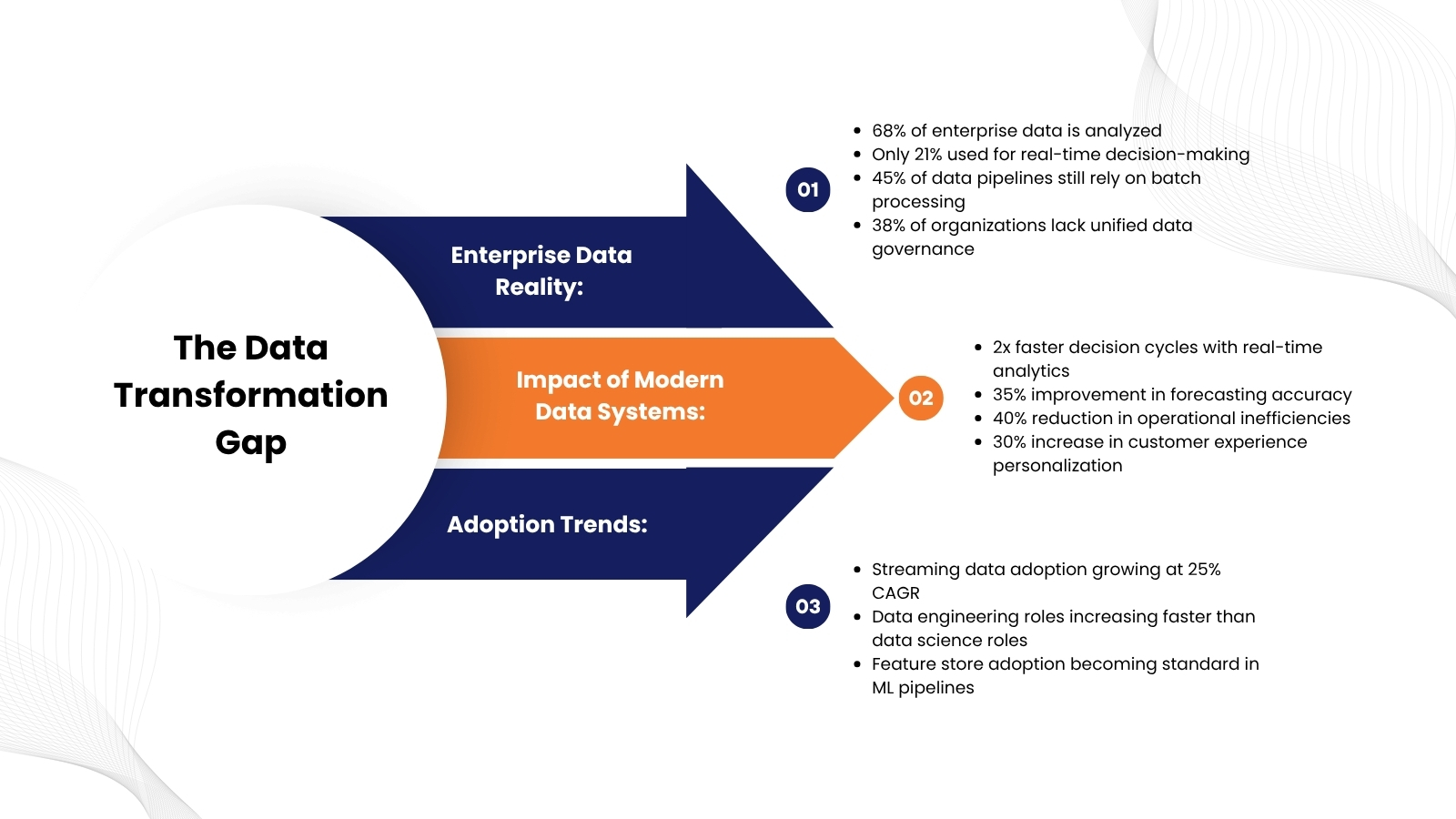
Recent industry benchmarks indicate that while enterprises analyze nearly 68% of the data they collect, only 21% is actually used for decision-making in real time. This gap highlights a deeper issue. The problem is not analytics capability. It is the absence of engineering-driven data systems that can translate insights into action.
Digital transformation today is no longer about dashboards or reporting layers. It is about building data-centric architectures where analytics and data science are embedded directly into business workflows.
The Shift: From Data Analytics to Decision Intelligence Systems
Traditional analytics models were built around retrospective analysis. Data was collected, processed in batches, and visualized through BI dashboards. While this approach provided visibility, it lacked immediacy and impact.
Modern enterprises are shifting toward decision intelligence systems, where:
- Data is processed in real time
- Models generate predictive and prescriptive insights
- Decisions are automated or augmented within workflows
This shift requires a fundamental re-architecture of data systems.
Instead of:
- Batch processing → Streaming pipelines
- Static dashboards → Embedded analytics
- Isolated models → Integrated decision engines
The transformation is driven by the need for low-latency, high-accuracy decision-making at scale.
Why Traditional Data Architectures Are Breaking Down
Legacy data architectures were not designed for the velocity and variety of modern data.
Key limitations include:
1. Batch-Oriented Processing
Traditional ETL pipelines introduce latency, making real-time analytics impossible for time-sensitive use cases.
2. Data Silos Across Systems
Data resides across CRM, ERP, IoT platforms, and external sources without a unified access layer.
3. Lack of Scalable Feature Engineering
Data science teams spend excessive time preparing data instead of building models.
4. Limited Integration with Business Applications
Insights remain confined to dashboards rather than being embedded into operational systems.
As a result, organizations face a paradox: high data availability but low decision impact.
The Rise of Data Engineering as the Backbone of Transformation
Data engineering has emerged as the foundational layer of digital transformation. Without it, advanced analytics and AI initiatives cannot scale.
Modern data engineering focuses on:
1. Real-Time Data Pipelines
Technologies such as event streaming and message queues enable continuous data ingestion and processing.
- Apache Kafka for distributed streaming
- Apache Flink and Spark Streaming for real-time computation
This allows organizations to move from delayed insights to instant decision-making.
2. Data Lakehouse Architectures
The convergence of data lakes and data warehouses into a unified architecture enables:
- Scalable storage for structured and unstructured data
- High-performance querying for analytics workloads
This eliminates the trade-off between flexibility and performance.
3. Feature Stores for Machine Learning
Feature stores standardize and manage features used in ML models, ensuring:
- Consistency between training and inference
- Reusability across models
- Reduced data preparation effort
This significantly accelerates model deployment cycles.
4. Data Observability and Reliability
Modern pipelines require monitoring for:
- Data quality
- Schema changes
- Pipeline failures
Data observability tools ensure that data systems are trustworthy and production-ready.
Cloud Cost Reality (2025–2026):
- 94% of enterprises struggle with cloud cost management
- 29% average cloud waste due to inefficiencies
- 41% of IT budgets allocated to cloud infrastructure
- 76% of large enterprises spend over $5 million/month on cloud
FinOps Impact:
- Up to 40% reduction in cloud costs via AI-driven optimization
- 30% improvement in forecasting accuracy
- 58% adoption of chargeback/showback models for accountability
- Real-time cost visibility across engineering teams
Market Momentum:
- FinOps market expected to grow from $14.88B in 2025 to $26.91B by 2030 at a CAGR of 12.6%
- Asia Pacific emerging as the fastest-growing region for FinOps adoption
Advanced Analytics: From Descriptive to Prescriptive Models
Analytics has evolved across four stages:
1. Descriptive Analytics
What happened?
2. Diagnostic Analytics
Why did it happen?
3. Predictive Analytics
What will happen?
4. Prescriptive Analytics
What should we do?
The real value lies in the last stage, where models not only predict outcomes but also recommend or automate decisions.
This is achieved through:
- Optimization algorithms
- Reinforcement learning models
- Decision trees integrated with business rules
For example, in supply chain systems, prescriptive analytics can:
- Predict demand fluctuations
- Optimize inventory levels
- Automatically trigger procurement decisions
The Convergence of Data Science and Software Engineering
Data science is no longer an isolated function. It is converging with software engineering to create production-grade data products.
This convergence introduces:
1. MLOps Frameworks
Ensuring models are:
- Version-controlled
- Tested and validated
- Continuously monitored in production
2. API-Driven Model Deployment
Models are exposed as APIs, enabling integration with applications and services.
3. Containerization and Orchestration
Using Docker and Kubernetes to:
- Scale model deployment
- Ensure portability across environments
4. Continuous Training Pipelines
Automating retraining processes based on new data inputs to maintain model accuracy.
This transforms data science from experimentation to engineering discipline.
Challenges in Building Data-Centric Digital Systems
Despite technological advancements, organizations face several barriers:
1. Data Quality Issues
Inconsistent and incomplete data reduces model accuracy and trust.
2. Skill Gaps
Shortage of professionals skilled in both data engineering and data science.
3. Integration Complexity
Connecting data pipelines with legacy systems and modern applications remains challenging.
4. Governance and Compliance
Ensuring data privacy, security, and regulatory compliance across systems.
These challenges highlight the need for a holistic transformation approach, rather than isolated technology adoption.
Engineering Digital Transformation Through Data
To unlock the full potential of data analytics and data science, enterprises must adopt an engineering-first approach:
1. Build Unified Data Platforms
Create centralized platforms that enable seamless data access across the organization.
2. Enable Real-Time Decision Systems
Integrate analytics directly into business workflows and applications.
3. Standardize Data Models and Pipelines
Ensure consistency, scalability, and reusability across use cases.
4. Embed Governance into Architecture
Incorporate security, compliance, and data policies into the data lifecycle.
5. Align Data Strategy with Business Outcomes
Focus on measurable impact rather than data volume or tool adoption.
The Skillmine Perspective: Engineering Data-Driven Transformation
At Skillmine, digital transformation is driven by data engineering, advanced analytics, and scalable architecture design.
Skillmine enables enterprises to:
- Build real-time data pipelines and modern data platforms
- Integrate advanced analytics into operational workflows
- Deploy scalable machine learning systems with MLOps frameworks
- Ensure governance, security, and performance across data ecosystems
This approach ensures that data is not just collected or analyzed, but translated into actionable intelligence at scale.
Digital transformation is entering a new phase where success is defined not by the amount of data collected, but by the ability to act on it in real time.
Data analytics and data science are no longer standalone capabilities. They are integral components of enterprise architecture and decision systems.
Organizations that invest in engineering-driven data systems will:
- Accelerate decision-making
- Improve operational efficiency
- Unlock new business value
In contrast, those that rely on traditional analytics models will continue to face delays, inefficiencies, and missed opportunities.
In the modern enterprise, data is not just an asset. It is an operational engine.